


Summary:

  • Plasmoid density triples, fusion energy rises with purer plasma
  • But not pure enough—LPP tracks down what disrupted the filaments
  • LPP has new paper for Spain conference
  • US Department of Commerce finds all in order with LPP-Iran Scientific “Fusion for Peace” Collaboration
  • LPP has rendezvous with Chu as Congress sets eye on ITER costs

Plasmoid density triples, fusion energy rises with purer plasma 

The density of the fusion-producing plasmoid is the key factor that must be increased for LPP to demonstrate the scientific feasibility of net energy production from Focus Fusion—net energy meaning more energy out than is lost in making that energy.  In the past month’s experiments, LPP’s research team has demonstrated the near-tripling of ion density in the plasmoid to 8x10¹⁹ ions/cc, or 0.27 mg/cc. At the same time, fusion energy output has moved up, with the best three-shot average increasing 50% to one sixth of a joule of energy. These results are not flukes, but part of an upward trend in density and energy since late February (see Figure 1), as the team reduced leaks in the vacuum chamber by over a hundred-fold. This reduced impurities entering the plasma from insulating oxide layers on the electrodes, thus improving the compression of the plasma.  In addition, at the end of March, LPP’s Derek Shannon refurbished the switches on FF-1, replacing worn plastic insulation, thus allowing the switches to fire in closer coordination.

The greater increase in density than fusion energy is expected, because as compression improves and the plasmoid gets smaller, its lifetime also decreases. So while density improves roughly as 1/r3, where r is radius, lifetime decreases proportional to r and energy output increases roughly as the product of the two, or 1/r2.

The higher density was determined by combining measurements of the total fusion energy and ion temperature derived from our neutron detectors, and measurements of plasmoid size from our ICCD-camera images. The LPP team has moved the camera to a new position, looking up close to the axis of the electrodes instead of side-on as previously (see next section). Our very first image from this direction (Figure 2) shows our smallest plasmoid yet observed with a core radius of only150 microns and core length of about 1.5 mm.

See full report here.

Summary:

  • LPP’s paper ranked #1 most- read in 2012 by the leading journal Physics of Plasmas
  • Ion beam peak power jumps four-fold to almost 400 GW, a new record
  • Compression improves, producing FF-1’s tiniest plasmoid, thanks to dramatic leak reduction

Recently published but not yet mentioned in monthly reports:

  • New collaboration begins with Japanese simulation group
  • Abell Foundation, LPP, Focus Fusion Society call for Senate hearings on US fusion program; letter-writing campaign begins

LPP’s 150-keV confinement breakthrough was the most-read article in 2012 among plasma physicists

On March 6, Physics of Plasmas, the leading international journal for fusion scientists, released a “ Listing of the Most Read Articles in 2012 Published in Physics of Plasmas. The number one article, most read out of the thousand published by the journal, was not from a giant national laboratory nor a large university group. No, it was “Fusion reactions from >150 keV ions in a dense plasma focus plasmoid”, from LPP’s small team:  Eric J. Lerner, S. Krupakar Murali, Derek Shannon, Aaron Blake and Fred Van Roessel. The paper described the confinement in a tiny plasmoid of ions  at a temperature of 1.8 billion ºC for  tens of nanoseconds, representing two of three conditions needed to produce net energy from hydrogen-boron fusion.  We had already known that this achievement was widely discussed among our fellow physicists. But this announcement shows that our peers considered this among the most interesting developments in the field during the past year, the one most worth their time to read. Better yet, with all those skeptical physicists reading our work, not one has sent us any criticism or correction. Many have offered congratulations and encouragement.

See the full report here.

Over the past few months, LPP’s experimental team has been trying to improve the symmetry of the compression that creates the plasmoid, so that the plasmoid will become smaller and denser. Higher density will make the fusion fuel burn faster and produce more energy output. Up until now, the core of our plasmoids, which are shaped like the sugar glaze on a doughnut, was no smaller than 300 microns in radius. Although this sounds pretty tiny, our goal was to get it down to 50 microns radius, with much higher density. We know that this is possible, as other researchers using similar plasma focus devices have observed and measured plasmoids this small. We also know that other researchers have achieved ion densities up to a few thousand times higher than what we have achieved, (hundreds of milligrams/cc vs our 0.1 milligram/cc) so we know that this too is possible.

A few shots after we got a record beam, on shot 7 of February 28, we also imaged our smallest plasmoid yet, shown in Figure 2, with a core radius of only 200 microns.  This image was taken several ns before the point of maximum compression, so the plasmoid has not fully formed and the smallest radius is probably somewhat smaller than 200 microns. The plasmoid core is seen forming at the narrowest “waist” of the pinch column, before the current has twisted itself up into the fully formed plasmoid. Like the “Big Beam,” we interpret this smaller plasmoid as the result of improved symmetry in our compression, due to our progress with the vacuum system.

Leaks squeezed down by 100-fold

When 2013 began, FF-1 was beset by persistent leaks.   These leaks were allowing oxygen to be present during our shots, so that the copper on the anode was rapidly oxidized in uneven patterns. Since copper oxide is an insulator, the current filaments had to cut through this oxide layer to reach the copper below.  In the process the filaments would wander around, getting closer to each other in some places and farther in others.  This in turn led to asymmetric compression and the “early beam” phenomenon, where energy would be released in filament collisions before compression was complete.

By early March, with the help of consultants and investors, LPP Chief Scientist Lerner and Lab Coordinator Derek Shannon had cut the leak down from 30 milliTorr/min at the beginning of January to only 0.3 milliTorr/min, by the beginning of March. First we got help from our new consultant, Brian Bures, who has had years of experience with small plasma focus devices. Then, we used an idea suggested earlier by LPP investor Rudy Frisch, who is a mechanical engineer. He suggested putting a Teflon restraining ring around the rubber O-ring that seals to the anode, forcing it to have a good seal when it is compressed. That got us a good seal before we fired, but a large leak re-opened after the first shot.

Another investor, Walter Rowntree, came to the rescue by acquiring on LPP’s behalf a Residual Gas Analyzer, a sensitive instrument that analyses and identifies the gas in the chamber. Using the new RGA, Shannon rapidly identified the main leak gas as isopropyl alcohol. We had been using the alcohol to check for leaks and it had gotten trapped in a cavity in the anode, bursting out when heated by the current in the anode. Draining the cavity solved the problem.

We are not quite through with leaks as we still have some oxygen in our chamber. But, as with previous engineering challenges such as arcing and high voltage switching, we expect that our growing understanding of the issues will enable us to solve the remaining leaks soon.

The ion beam produced by a plasma focus device will be the primary means of getting electric power out of the device. On February 28, while firing Focus Fusion-1 (FF-1), LPP’s experimental plasma focus device, the team observed a record 380 GW peak power in the ion beam. The previous most powerful beam observed had a peak power of 93 GW, so the new beam is a four-fold improvement.  In addition, this was the first beam observed that, at least in part, went all the way down the meter-long drift tube that is attached to the underside of the FF-1 vacuum chamber. It was also the first beam that equaled or exceeded our theoretical predictions. Both the higher peak power and the beam’s more vertical direction are signs of increasing symmetry of the compression that forms the plasmoid, a key goal of LPP’s current efforts.

To give some context for this large power output, the peak input power to FF-1 device from its capacitor bank is currently around 53 GW while the total average electric power used in the United States is 440GW. Indeed, the beam was probably considerably more powerful than the figure we measured, as LPP’s Chief Scientist Eric Lerner calculated that about half the beam spread out beyond the 1-cm wide entrance hole to the drift tube. We believe this is the most powerful beam ever measured from a plasma focus device, although we will have to search the literature more thoroughly to make that claim with certainty.

Of course, the beam only lasted 5-ns, so it and the equally powerful electron beam emitted in the opposite direct carried only about 4 kJ of energy, about 1/15th of the total energy fed into the electrodes during the much longer 2-microsecond rise-time of the current from the capacitors. To get more energy out of the beam than is put in will require much higher fusion yield than is presently obtained in FF-1. 

Fig. 1 The Big Beam of shot 4, Feb.28 as recorded by the Upper Rogowski coil. (This is actually an integrated signal, as the coil signal is proportional to the rate of change of the current.)

The LPP team measured the ion beam with two Rogowski coils near the top and bottom of the drift tube. When a beam of ions or electrons passes through these coils, a current is induced in them, creating a signal that is stored on an oscilloscope.  Figure 1 shows the signal from the Upper Rogowski coil, close to the plasmoid, with the large beam to the left and a smaller subsequent beam on the right some 35 ns later.  The dips following the beams show a reverse current of electrons drawn along behind the ions.

The height of the integrated Rogowski signal gives the peak current in the beam. The difference in timing between the two Rogowski signals gives the velocity of the beam and thus the energy of its ions—in this case 3MeV (million electron volts), again a new record for FF-1. We can check this energy by comparing the timing of the Rogowski coils with the timing for the signal from an x-ray detector, or photomultiplier tube, that detects when the electron beam hits the anode. Again the result is the exact same energy of 3 Mev. By multiplying the average energy by the peak current of 127 kA, we get the peak beam power of 380 GW.

On March 6, Physics of Plasmas, the leading international journal for fusion scientists, released a “ Listing of the Most Read Articles in 2012 Published in Physics of Plasmas. The number one article, most read out of the thousand published by the journal, was not from a giant national laboratory nor a large university group. No, it was “Fusion reactions from >150 keV ions in a dense plasma focus plasmoid”, from LPP’s small team:  Eric J. Lerner, S. Krupakar Murali, Derek Shannon, Aaron Blake and Fred Van Roessel. The paper described the confinement in a tiny plasmoid of ions  at a temperature of 1.8 billion ºC for  tens of nanoseconds, representing two of three conditions needed to produce net energy from hydrogen-boron fusion.  We had already known that this achievement was widely discussed among our fellow physicists. But this announcement shows that our peers considered this among the most interesting developments in the field during the past year, the one most worth their time to read. Better yet, with all those skeptical physicists reading our work, not one has sent us any criticism or correction. Many have offered congratulations and encouragement.

This interest is validation by our peers of LPP’s own view, expressed in our last report, that we are the leading R&D laboratory for aneutronic, radioactive-waste-free fusion, the only known means that can produce safe, nonpolluting, and unlimited energy at a cost well below that of existing technology.

FOR IMMEDIATE RELEASE

Feb. 6, 2013

Middlesex, NJ

Contact: Eric J. Lerner 732-356-5900, 908-546-7654


Scientists at green energy start-up Lawrenceville Plasma Physics, Inc. (LPP) today endorsed the recent call of the Abell Foundation’s Executive Director, Robert Embry, for the establishment of Senate hearings to investigate if the US fusion energy program is too narrowly focused and needs to be redirected to a broader range of fusion devices, including those that could lead to energy sources cheaper than any now available.  Fusion has long been pursued as the “Holy Grail” of clean, cheap, baseload power with no nuclear waste, but the US government has concentrated its funding into just two possible approaches, while ignoring much less expensive alternatives that have recently shown new promise.  See the rest of this article here. 

See the Letter to Senator Wyden here.

LPP Announces New Collaboration Agreement with Plasma Simulations Group, University of Toyama, Japan—Simulation Yields First Results

 On January 15, 2013, Lawrenceville Plasma Physics Inc., (LPP) and the Plasma Simulation Group, Graduate School of Science and Engineering, University of Toyama, Japan, signed an agreement to collaborate on scientific work on the dense plasma focus and aneutronic fusion, concentrating on simulation of the plasma focus process. This is the second in a series of collaboration agreements LPP is arranging to create a coordinated network of plasma focus and aneutronic fusion researchers throughout the world. The agreement will be administered by Dr. Takayuki Haruki of the Plasma Simulation Group (PSG) and Eric J. Lerner, Chief Scientist at LPP. As with other collaboration agreements, the goal is to speed the achievement of cheap, clean, safe and unlimited energy.

Since the PSG has worked on simulations in this field for a long time, they were able to produce a preliminary simulation in a just few weeks. This simulation, presented at the Sokendai Asian Winter School on Jan. 29-Feb. 1, 2013 at NIFS, Toki, Japan, (http://www-nsrp.nifs.ac.jp/aws/index.shtml) is a first approximation of the process that leads to the formation of plasmoids in a plasma focus device. Plasmoids are dense knots of plasma where the atomic nuclei are heated to high temperatures and fusion reactions occur. They form when filaments of electric current first merge with each other into a single central filament which then twists and knots itself into a plasmoid.  LPP itself is working on a simulation of the formation of the filaments during a single pulse of the plasma focus device.  See the whole article here.

  • 0 Comments

January 28, 2013

The Honorable Ron Wyden

221 Dirksen Senate Office Bldg.

Washington, D.C.  20510

                                                                          Dear Senator Wyden:

Congratulations on your ascendency to chair of energy and natural resources.  In that role there is one issue I would like to call to your attention.  The scientific consensus, as you well know, is that mankind is discharging too much carbon into the atmosphere.  What is needed is a clean, cheap baseload energy source that does not emit carbon.  While solar and wind are non-polluting, they supply only intermittent expensive power.  Arguably the only promising alternative is fusion energy which holds the promise of clean, cheap, baseload power with no nuclear waste.  Unfortunately while the U.S. government realizes this, it has chosen to pour millions into one possible fusion technology that has so far failed, and ignored less expensive promising alternatives. See full letter here.

  • 0 Comments

2012 Summary:

  • LPP published in a leading peer-reviewed journal, Physics of Plasmas, our achievement of two out of the three conditions needed to produce net energy: a record-high temperature and the required confinement time of the hot plasma.

  • LPP demonstrated that our approach is, by far, the leader in the effort to achieve aneutronic, radioactive-waste-free, fusion--the only known route to clean, cheap, safe, and unlimited energy.

  • LPP eliminated arcing problems in the FF-1 fusion device that were blocking progress; it developed and used simulations to improve the FF-1 fusion device design, and acquired a greater theoretical understanding of FF-1’s 1.8 billion- degree temperatures.

In 2013:

If $1.5 million in financing is raised in January, we expect to achieve proof of scientific feasibility (more energy out than in) in 2013, but only with such timely funding.

Our main achievement in 2012 was to demonstrate, as described in our publication in Physics of Plasmas, the world’s leading plasma physics journal, that we had achieved the sufficiently  high temperature of 1.8 billion ºC and the sufficient confinement time of tens of nanoseconds necessary to produce net energy from hydrogen-boron fusion. This means that we have achieved two of the three conditions needed for net energy—the third being sufficient density of the plasma.  See full article. See comparison of aneutronic fusion approaches.


LPP’s latest presentation “Fusion Energy: Might we finally achieve it?” is ranking near the top in video searches for fusion energy. Over 7,000 people have already viewed this presentation by the LPP team, hosted October 12th by the Center for Economic & Environmental Partnership, Inc at the Times Square offices of Ernst and Young in Manhattan. The presentation was organized by center director Gelvin Stevenson, who was contacted by LPP Senior Consultant Sam Salamay. LPP’s Chief Information Officer, Ivana Karamitsos, designed the presentation’s graphics and edited it into a finished version that has now had a reach far beyond the original thirty audience members.  The presentation transcript is available as well. The new video adds considerably to LPP’s web presence, which already includes several widely-viewed videos either by us or about us on mass media such as RT (Russian Television).


  • Arcing problem looks solved, leak delays new tests
  • Photos confirm plasmoid structure
  • SESAME’s Israel-Iran cooperation shows Fusion for Peace is no pipe dream

Summary: Two shots with no arcing indicate the problem is solved, although more proof is needed. A leak held up key tests while we implement a solution. Analysis of photos taken in October confirms our understanding of plasmoid structure. The SESAME physics cooperation project, involving both Israel and Iran, shows that intergovernmental research like our Fusion for Peace proposal is feasible politically.

Arcing appears to be solved for now, but a leak causes delay


Two shots fired by LPP’s FF-I dense plasma focus on Nov. 13 may have signaled the end of a months-long effort to overcome arcing within the device. Arcing, the uncontrolled jump of electric current between two conductors which leads to vaporization of the metals, has interfered with our efforts to achieve symmetric compression of the plasma and the high densities we need for higher fusion yields. By November 10th, we had installed a new all-tungsten cathode plate to eliminate arcing within the former hybrid plate, which consisted of a tungsten ring of teeth vacuum brazed to a copper plate. See full report

LPP at American Physical Society 2012 Plasma Physics Conference: Strengthening our lead in the race towards fusion power

This update was part of LPP's November 2012 progress newsletter.  Download a PDF of the full newsletter here.

LPP Chief Scientist Eric Lerner, accompanied by visiting scientist Dr. Hamid Yousefi of the Plasma Physics Research Center in Tehran, and Ahmad Talaie of Utah State University (our most recent summer graduate research fellow) participated in the annual American Physical Society Plasma Physics conference in Providence, RI, October 29-November 1 (conveniently riding out Superstorm Sandy away from NJ while LPP’s Derek Shannon held down the fort.)  The conference provided new information and opportunities, but the most important conclusion for us was the lead that LPP’s Focus Fusion effort maintains over other approaches. This, of course, is no guarantee that our approach will actually get to a practical fusion generator first, but it is a snapshot of the fusion race right now.

Tri Alpha Energy, which is pursuing aneutronic fusion with a different device from the plasma focus, presented their past year’s progress with a half-dozen poster presentations. The clear and thorough presentation of their results was due a shift in management approach to a new openness, according to several of the researchers participating.  Tri Alpha’s device, called a Field Reversed Configuration or FRC, generates two large rings of plasma and heats them with an externally accelerated ion beam. Their most recent results show that they have confined plasma at about 100 eV energy for about 2 milliseconds at a density of 2x10¹³ ions/cm3. A rough measure of overall progress is the product of these three numbers, called “ntT”, which for Tri Alpha is 4x10¹². By comparison, LPP’s FF-1 with an ion energy of 160 keV, confinement time of about 30 ns and density of 3x10¹⁹ ions/cm3 has a  ntT product of 1.4x10¹⁷, a factor of about 30,000 larger than that of Tri Alpha. This puts LPP far closer to the goal of net energy for now. Tri Alpha has raised about $140 million in private investments and works with a staff of 30 physicists.

LPP feels strongly that all possible routes to aneutronic fusion should be researched, as long as we don’t know for sure which one will work. We expect to continue discussions with the Tri Alpha team about possible avenues of cooperation.

Lerner’s presentation on LPP’s experimental progress was attended by about 60 researchers, a good turn-out. We explained our latest progress on understanding how arcing affects the formation of filaments and our efforts to overcome this. Our latest work shows that arcing lays down irregular deposits on the insulator and anode which in turn leads to an uneven spacing of the filaments. When closer-spaced filaments collide during compression, they generate the “early beam” phenomenon and prevent full compression and high density of the plasma.

Our new micro-ohm meter allowed us to test for the contact resistance that causes arcing without assembling and testing the whole machine. But continuing small resistances forced us to switch from the copper cathode plate with tungsten ring to an all-tungsten plate. We did not have time to test that new plate before the conference (and the simultaneous storm). Despite this anti-climatic conclusion, our presentation was well-received with good questions and several researchers complimenting the work afterwards. Several researchers appreciated our addressing the detailed technical problems that are often overlooked in reporting scientific results and were impressed by the progress we are making.

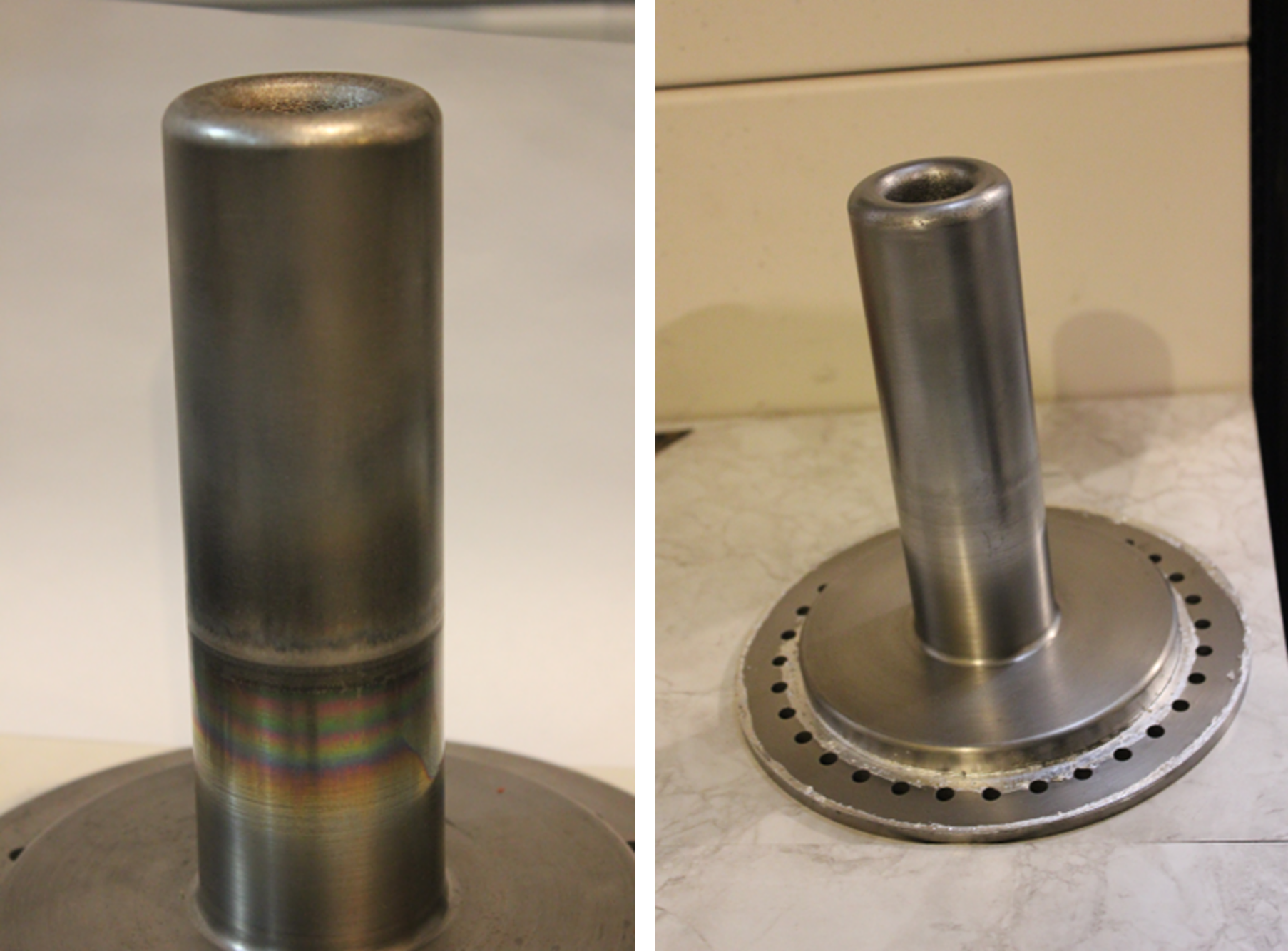
The sawteeth below are one solid piece with the tungsten base, eliminating a current contact that had caused arcing.  The teeth concentrate electric fields to enhance filamentation in the plasma sheath that extends outward to the copper rods.

Talaie and Lerner’s theoretical description of heating due to plasma viscosity and the currents induced by the electron beam unfortunately reached a smaller audience, in part because our poster happened to be located in the far corner of the hall, but the insight this work provides for further progress is no less valuable.

At least two possibilities for collaboration arose at the conference. University of Alabama has received some funding for fusion space propulsion from NASA, and researchers there are interested in a possible collaboration with LPP in designing plasma focus devices for a new, powerful mega-ampere facility there. Researchers at Lawrence Livermore National Laboratory have developed a computer simulation of the compression phase of plasma focus functioning and may be willing to collaborate with LPP to benchmark their simulations against our detailed experimental results. We will be following up both possibilities in the coming month.

Former DOE Fusion Chief, Robert Hirsch, says aneutronic fuel is path to fusion, and the tokamak will not provide practical energy

This update was part of LPP's November 2012 progress newsletter.  Download a PDF of the full newsletter here.

“So where are we likely to find practical fusion power? First, we must look for a concept or concepts that are inherently small in size, which means high plasma density. Second, we must look for something that can be based on a low or zero neutron fusion reaction. One example is the proton-boron reaction.”

--So said Dr. Robert L. Hirsch, in a presentation given at the 14th U.S.-Japan IECF Workshop, October 16, 2012, and then widely reported in the New York Times blog, Dot Earth. In the same presentation, Dr. Hirsch concluded that the tokamak cannot lead to practical energy sources because it is too large, too expensive, and does not avoid radioactive waste due to neutron production.

Dr. Hirsch’s views are notable because, 40 years ago, he was director the Department of Energy’s fusion research program and was a key figure in pushing the program into its narrow emphasis on tokamaks, a major error that Dr. Hirsch now acknowledges. It is not news that Dr. Hirsch thinks tokamaks are a dead-end, as he has been saying something like this for about 15 years. But this is the most forceful statement he has made of these views, and the first to gain widespread media attention.

The only specific approach for aneutronic fusion that Dr. Hirsch cited in his speech was Inertial Electrostatic Confinement (IEC), which is understandable, since he was a pioneer of this approach before becoming an advocate of the tokamak, and the presentation was directed to an IEC workshop. (In response to various requests, LPP will soon release a comparison of the plasma focus with IEC and other approaches to aneutronic fusion.)

The attention given to Dr. Hirsch’s negative analysis of the tokamak came only a few weeks after a government report on the National Ignition Facility (NIF) revealed that it had essentially no chance of reaching fusion ignition (the self-heating of a plasma by fusion reactions) in the foreseeable future. NIF, based on a giant laser array, and the tokamak program have consumed (and still consume) the vast majority of US funding for fusion research. These two analyses show that it is long past due for the government to redirect its fusion funding in more inclusive directions.

Skepticism towards aneutronic fusion fuels has hindered LPP's ability to raise funds from governmental and other sources, since these funds are currently directed primarily towards the deuterium-tritium fusion approaches (especially tokamak) that are considered "easier" because of the lower ignition temperatures D-T requires.  Fortunately, LPP published in March 2012 the achievement of ion energies sufficient for fusing the aneutronic fuel combination hydrogen and boron, and we hope this technical progress along with new statements like this one from Dr. Hirsch will continue to increase the odds for a more diverse fusion program with a greater likelihood of both scientific and commercial success.

Below: Artist’s concept of a polywell IEC generator by Torulf Greek, who is also responsible for LPP’s Focus Fusion depictions.  Join conversations about the polywell and other fusion approaches at talk-polywell.org, focusfusion.org, and fusionenergyleague.org.


PPRC’s Dr. Hamid Yousefi visits LPP for 3 weeks, furthers scientific publication collaboration, proposal to IAEA on the horizon

This update was part of LPP's November 2012 progress newsletter.  Download a PDF of the full newsletter here.

From October 14 to November 3, Dr. Hamid Yousefi, an internationally-known researcher in aneutronic fusion and long-time collaborator of LPP’s Chief Scientist Eric Lerner, visited LPP’s NJ lab and participated in its research activities. Dr. Yousefi is a professor at the Plasma Physics Research Center (PPRC) in Tehran, which recently agreed to collaborate with LPP on scientific publications in the field of aneutronic fusion.  Collaboration for the purpose of publishing scientific papers is exempt from ongoing sanctions, and LPP with other scientists launched this "Fusion for Peace" effort in Spring 2012 in hopes that progress on fusion can help move us beyond conflicts relating to both fission technology and fossil fuels.

While here, Yousefi had long discussions with the LPP team on the details of the Focus Fusion effort. The scientists also finalized a first step in the collaboration agreement. This is to propose to two PhD plasma physics students at PPRC that they initiate theses based on analyses of neutron and x-ray data from LPP’s Focus Fusion-1 (FF-1) experiment. Through this effort, LPP will be able to obtain skilled analysis of data that we have simply not had time to study in detail, and PPRC students will get access to an unparalleled data set from a large plasma focus fusion experiment. (While Iran has several plasma focus groups--more than any other country!--none can use deuterium or other fusion fuels, due to the sanctions against Iran.  No materials or funds are to be transferred between LPP and the PPRC.)

In addition, Dr. Yousefi and another PPRC colleague, Dr. Pejman Khorshid, who also paid a brief visit to LPP, have had discussions of the Fusion for Peace initiative with representatives of the International Atomic Energy Agency. Based on these discussions, we are proposing to the IAEA the establishment of a Collaborative Research Project for Aneutronic Fusion. Such an international collaboration under IAEA auspices, if approved, will make it easier for many groups in the US, Japan, Australia, and elsewhere to collaborate with us and Iranian researchers without concerns about potential violations of the sanctions on Iran.

Below (l-r): LPP’s Derek Shannon and Eric Lerner smile for peace alongside Professor Hamid Yousefi of the Plasma Physics Research Center in Tehran—Hamid’s young son was very eager for pictures from his dad’s trip!

Press Statement on the Impact of Hurricane Sandy and the Need for Aneutronic Fusion

For immediate release - November 6, 2012

Click for .PDF

Today, one week after Hurricane Sandy hit New York and New Jersey, millions remain without power and communications. Gasoline is still in short supply. This is the third major power outage in this area in 15 months, so it is no fluke of nature. While some of Sandy’s damage was the unavoidable result of a powerful storm, the collapse of the region’s energy infrastructure was wholly avoidable and we must take steps to prevent it in the future. 

Some steps are obvious and can be done with existing technology. Power lines and transformers everywhere must be buried underground in water-tight conduits, so that every tree and branch does not become a threat to the power grid.

But the sudden implosion of the gasoline supply in New Jersey, home of many of the nation’s largest refineries also shows the dangers of reliance on centralized sources of energy. If energy flows from a few choke points outwards, it becomes extremely vulnerable to disruption.

Surely the series of disasters we have witnessed in the past two years—the Deep Horizon oil spill, the Fukushima meltdowns and now the widespread and lasting power disruption following Sandy—should convince us that we do urgently need a new source of energy.  We need energy that is safe, reliable, clean and distributed—spread out in many locations so that a few disruptions do not knock out an entire region.

Aneutronic fusion could provide that new source of energy, if it is successfully developed. Aneutronic fusion is nuclear energy with no radioactive waste. It uses the same process that gives light to the Sun and other stars—nuclear fusion—to derive huge amounts of energy from tiny amounts of non-radioactive fuels such as hydrogen and boron. The ‘ash’ from this process is the useful element helium.  Aneutronic fusion generators can be small and safe, without any large fuel storage on site, so they can be located in many communities, close to energy demand. This would make it impossible to knock out a whole region’s power by a localized disruption. In addition, they require tiny amounts of fuel—several pounds a year, so fuel delivery would never be threatened. Finally, such small generators, producing power directly without expensive steam turbines, could be much cheaper than any existing power source and their fuel is abundant enough to last for billions of years into the future.

No working aneutronic generators exist today—they have to be researched and developed.  The fusion process requires temperatures of billions of degrees, hundreds of times that in the center of the sun. Yet scientists, here at our small laboratory in Middlesex NJ, and at other research facilities, have achieved such extreme temperatures with experimental devices. More research must be done to also achieve the rate and duration of fusion burn needed to produce net energy—more energy out than in. Then, much engineering would be needed to produce a reliable generator ready to install.

Today, scientists are at work on at least five devices that could become aneutronic fusion generators, and more and more researchers are recognizing that this is the path toward the cheap, clean, safe and reliable energy we need. But far more resources are needed to make this potential a reality. We at LPP have joined with researchers in other countries to advocate the establishment of an International Aneutronic Fusion Program, funded by several governments, to accelerate and coordinate this research and development effort. We urge all who want a new source of energy as soon as possible to support this initiative. You can show your support by signing the Fusion for Peace petition, and by organizing local Fusion for Peace groups to educate others. Together we can end energy disasters.

Fusion Energy: Will we finally reach breakeven?

LPP's chief scientist Eric Lerner explains who's who in the world of fusion energy research and what's the latest in plasma physics and nuclear fusion. This presentation was hosted by the Center for Economic & Environmental Partnership at the Ernst & Young location in New York City's Times Square, on  October 12 2012.

Tighten your seat belts for this exciting overview of current technologies and the potential for cheap, safe and clean energy in the near future!

{youtube}OM4talPKvtU{/youtube}

Summary: Arcing persists, but there is a “silver lining” (literally) and a new micro-ohm meter will help. Experimental evidence shows that we are producing the fine filaments we need for high density and greater fusion yields, but they are disrupted by arcing.

Click here for a PDF of this report with additional images.

Arcing occurs when electric current jumps through tiny gaps between two pieces of metal carrying the current, causing vaporization of the metal. The uneven mixing of metal vapor with FF-1’s deuterium plasma disrupts the symmetry needed for good compression and thus high density.

Above: Ivana Karamitsos and Derek Shannon stack layers of adhesive kapton film, taking care not to create bubbles that would leave room for electrons to accelerate. These four layers of kapton are then cut and applied to the inner steel buss to protect the ceramic hat insulator from “feelers” of electricity that could lead to breakdown.

LPP’s research team is convinced the arcing can be cured, since our colleagues in other facilities, with similar currents, have licked this problem. It is a question of our learning and applying the best techniques to do this right. In our small field, the answers are not in textbooks, but we believe we have enough insights to provide the answers after a little more experimenting.

The first tests of our new method of attaching the tungsten teeth to the copper cathode plate were delayed by machining and aligning glitches until the end of July. Those tests showed that we had solved the arcing between the tungsten and copper. But arcing persisted between the copper pieces and the steel plates to which they are bolted. (See our Illustrated Intro to Arcing, below.) This arcing seemed to be due to microscopic gaps between the copper and steel, which could be smoothed out by applying greater pressure to the bolts. We had previously doubled the number of these bolts from sixteen to thirty-two, and in August we substituted stronger titanium bolts for the brass bolts in the cathode and increased the stress on the anode’s steel bolt. Nonetheless, arcing still occurred. Our new resistance and waveform tests (reported in June) helped us to detect arcing quickly, but we had to take time to repair arcing damage to the electrode surfaces.

A renewed search of the literature turned up data that showed that the contact resistance—the resistance between the two conducting plates—could not be reduced sufficiently by the pressure we could apply. To avoid arcing, the voltage difference between the two plates has to be reduced to about a volt. With million-amp currents, this means the contact resistance has to be less than one micro-ohm. The published studies showed that, with our design, we could not achieve the pressures needed to get to that level.

So, based on suggestions by our colleague Chris Hagen of the NSTEC Gemini dense plasma focus facility at the Nevada National Security Site, we put indium wire between the two plates. Indium is a very soft, conductive metal that squishes out to form a good bond between two metals. In our first test of this method in early September, arcing was reduced, but was still substantial. Since metal is one million times denser than our plasma, any arcing is harmful.

Thanks to a timely visit by Focus Fusion supporter and New Zealand chemical engineer Chris Lee (pictured at left with LPP Chief Scientist Eric Lerner, right), we rapidly saw that we had overlooked one source of contact resistance. The stainless steel plates are covered with a protective layer of chromium oxide. This keeps them shiny, but has a high electrical resistance. When current flows, the thin layer of oxide cracks, but only lets through thin spurts of current, keeping contact resistance high and allowing for arcing.

To eliminate the oxide coating we are plating the steel pieces with nickel and then silver (the silver lining), which will allow a continuous metal contact from the silver-coated copper, through the indium to the silver-coated steel.

In addition, we have ordered a micro-ohm meter that can measure the tiny contact resistances that cause arcing. This means we can test our electrodes before putting them in the machine and firing. Since electrode assembly takes a couple of hours, and assembling, firing and taking apart FF-1 takes a week, we expect that any remaining problems, if they exist, will be far more rapidly detected and resolved.

Tracks on insulators show tiny filaments, and the effects of arcing

Since we have been firing only a few shots during each test cycle, we have been able to see the tracks made on the insulators by individual current filaments. The arcing produces carbon that mixes with the filaments’ plasma and then is deposited on the insulator. This plasma “writing” has shown us the filaments are indeed forming at about the 100-micron diameter we predicted (see figure 2). But they are irregular and, in the area of most severe arcing, they don’t appear. This is firm evidence that the arcing is disrupting the filamentation needed for high density and thus high fusion yield.Since the arcing occurs at a different place than the filament formation, and there is not enough time for the blast from the arcing to hit the filaments, arcs are probably affecting the filaments indirectly, by depositing an uneven layer of contaminants like carbon onto both the anode and insulator surface. As the filament in the next shot passes over these contaminants, they pick up a heavy dose of heavy elements. This can either disrupt the filament entirely—like throwing tennis ball through a smoke ring—or cause them to move more slowly than less-contaminated ones. Even a change in filament velocity of only a few percent can cause them to arrive too early or too late for good compression.

This plasma writing gives us greater confidence that as soon as the arcing is fixed, better filamentation, higher densities and higher yield will be produced.

Below: After disassembling due to arcing after just four shots (with just one pinch, the type of shot in which fusion occurs), inspection of the hat insulator showed lines left as the traces of filaments. The filaments deposited material that had contaminated the plasma through arcing, leaving an outline of their shapes before they moved away from the insulator.


With NASA's @MarsCuriosity rover set for a spectacular mission of exploration in Gale Crater, what are the prospects for a near-term fusion breakthrough that would accelerate human voyages and help us here on Earth? Courtesy MediaArchives.com, Derek Shannon of Lawrenceville Plasma Physics shares the latest on the company's Focus Fusion-1 experiment underway in Middlesex, New Jersey, with attendees of the 15th Annual Mars Society Convention on the eve of Curiosity's historic touchdown.

{youtube}r4Wngo2hX8g{/youtube}


Resistance measurements show way to higher peak current in FF-1


Peak current is one of the key parameters in getting to higher yield, as for every doubling of current we expect roughly a 30-fold increase in fusion energy. Studies by LPP electrical engineer Fred Van Roessel have indicated that in the recent shots in May, where we experienced arcing problems, the resistance of the device was much higher than usual. If we confirm that this resistance is in fact due to arcing, then our steps to eliminate arcing can boost total current delivered over 2 MA—close to our design goal-- even with the switches we are now using.

The resistance—a measure of how much of the current is dissipated as heat—reduces the current delivered to the plasma. It can be measured by looking at the wave of current that occurs when there is no pinch. (The pinch and subsequent formation of the plasmoid greatly complicate matters by consuming a lot of energy.) Van Roessel fitted theoretical curves (see figure 1) to the measured ones. The faster the current wave decreases, the more the resistance. He found that in the May shots, resistance was as high as 17-20 mOhms, while in earlier shots, with less arcing, resistance was only 5-6 mOhms. In theory, the metal parts of FF-1 that carry the current, the switches and capacitors should have no more than 2 mOhms resistance.

While these resistances may seem small, at FF-1’s very high current, they are very significant. At 1 MA, a resistance of 20 mOhms creates a voltage drop of 20 kV, half the entire charging voltage of the capacitors.

If, as seems likely, the change in resistance is due to arcing, we believe that the total elimination of arcing, which we are working on now, may drop the resistance to as low as 2 mOhms. In that case, simulation programs developed by Dr. Sing Lee predict that with full power, shorter electrodes, and our existing switches, FF-1 will produce over 2.3 MA, over twice our current output. New, faster switches now under design for LPP by Raytheon will get us the rest of the way to our goal of 2.8 MA.

Figure 1: FF-1’s resistance calculated by matching calculated and observed curves.

  • 0 Comments

New theoretical work shows how FF-1 gets ions to 1.8 billion C.  Iranian group- independently confirms LPP theory (Apologies for length of this important item!)


Theoretical insights and calculations by LPP’s Chief Scientist Eric Lerner and our new summer graduate student, Ahmad Talaei of Utah State University, as well as work by an independent group of physicists at Amirkabir University of Technology in Tehran, have provided a long-sought explanation on how FF-1 has managed to achieve record breaking ion energies, four times hotter than LPP’s earlier theory had predicted. The new theoretical improvement will help us to understand and more efficiently guide further experiments.  This work and the independent confirmation of our theoretical calculations by the Iranian group reinforce our confidence that our high temperatures will indeed be able to ignite the ideal fusion fuel, hydrogen-boron.


Since we first observed the 160 keV energies of the ions (equivalent to 1.8 billion C) over a year ago, we had been puzzled as to why they were so much higher than the 40 keV we had predicted. We knew that the earlier predictions, based on theories developed by Australian physicist Heinrich Hora, were only approximate and needed a better physical foundation.  But we had not, until now, come up with an improvement.


The first big step to the solution came May 15, with the publication online in the Journal of Fusion Energy of a paper by the Iranian team, S. Abolhasani, M. Habibi, and R. Amrollahi, “Analytical Study of Quantum Magnetic and Ion Viscous Effects on p11B Fusion in Plasma Focus Devices.”   The paper studied in greater detail the quantum magnetic field effect originally applied to the DPF by Lerner, for the first time independently confirming our calculations showing that ignition and net energy gain can be achieved with pB11 (hydrogen-boron) fuel, the key to obtaining aneutronic fusion energy.  Above: Eric and visiting grad student Ahmad Talaei during a visit to Princeton’s physics library


But in addition, the paper applied to the plasma focus device a process studied by British physicist Malcolm Haines to explain high ion energies achieved in the Z-machine. That process, called “ion viscous heating” works like this: as the plasmoid contracts, ions moving inward at different velocities start to mix together, so that their ordered velocity of motion is converted into the random velocity of heat. By analogy this is a bit like trying to rapidly stir a vicious liquid like honey. The resistance of the liquid to rapid changes in velocity—its viscosity—converts kinetic motion to heat and the liquid warms up. The formulae derived in the paper indicated that this viscous heating could possibly explain FF-1’s high temperatures.


But there was a second puzzle to be solved. The viscous process heats only the ions—the heavy nuclei—not the electrons. If the electrons are too cold, collisions between them and the ions would rapidly cool the ions. So what heated the electrons up hot enough so they would not cool those ions too fast? We had known for many years that the electron beam could not directly heat the electrons in the plasmoid enough. The very fast-traveling electrons in the beam don’t stay near other particles for long enough to effectively heat them by collisions. Some other process must help—but what could it be? Lerner had puzzled over this for years and Dr. Hora’s theory gave only a very partial answer.


On June 10, Lerner thought of a possible solution. The electron beam will induce currents in the plasmoid electrons, just as any rapidly changing current induces other currents in a surrounding conductor (we intend to use this same process to capture the energy of the ion beam with a coil of wire). But since the plasmoid has a much greater density of electrons that the beam, the same current will be distributed over more electrons, and they will be moving much slower than the beam electrons. These slower electrons will have the time to undergo collisions and convert their kinetic energy to heat.  Following up on this hypothesis, Talaei found a dozen important papers on this same process of electron beams heating plasma by induced currents, although none applied directly to the plasma focus.  Curiously, all the papers dated from the 1970’s, the same fertile period that gave rise to the first research on the magnetic field effect.


When we combined the formulae from these papers for electron temperatures with the formulae from the viscous heating paper and plugged in the observed values for plasma density, radius and current from FF-1’s experiments, the predicted ion energy came out to 170 keV—in terrific agreement with our best observed results of 160 keV. Of course more experiments will be needed to fully confirm that this theoretical explanation is right, but this combination of processes is clearly a possible explanation.


Interestingly, the effectiveness of the ion viscous heating declines rapidly with increasing density of the plasmoid and smaller plasmoid size, while the effectiveness of the induced current heating rises for smaller, denser, plasmoids. So as we increase plasmoid density we expect to see a temporary decline in temperature, and then a subsequent rise back to the levels needed to burn pB11. Fusion yield will continue to rise, as the higher density and thus higher burn rate will more than compensate for the temporary decline in T.


Long as this tale already is, we will have more to say on this heating story in the future!

  • 0 Comments

Newsletter Subscriber

Prove you're human(ish) to sign up: What's 2 cubed?
Name:
Email:

Quick Contacts

128 Lincoln Blvd.
Middlesex, NJ 08846-1022

Phone: (732) 356-5900
Fax: (732) 377-0381

Click Here to Email

anti-SHRILL web design

I think that the “Focus Fusion” approach of Lawrenceville Plasma Physics, Inc. should be funded as the science behind it is very interesting. Even if this approach does not succeed in producing fusion energy, the research will produce valuable technology in the near term. - Bruno Coppi, Professor of Physics and Senior Fusion Researcher, MIT

The experimental program that LPP plans to carry out has great potential to show how the plasma focus can be used to generate fusion energy and to demonstrate the feasibility of hydrogen-boron fusion. In addition, the experiments will investigate the magnetic effect, which will be very exciting. Achieving giga-gauss magnetic fields with the plasma focus, getting gyro-radii of the order of the electron Compton wavelength, will certainly be new physics and will open up large new possibilities for energy production. - Dr. Julio Herrera, Professor of Physics, National Autonomous University of Mexico